

Agent Hook
roborev agent-hook is an opt-in integration with the Codex and Claude Code harness hook systems. roborev reviews your commits in the background; agent-hook watches the agent boundary and, once review work has piled up, returns one instruction telling the agent to run the $roborev-fix skill before the session goes cold. It is the in-tree replacement for the standalone roborev-hook tool.
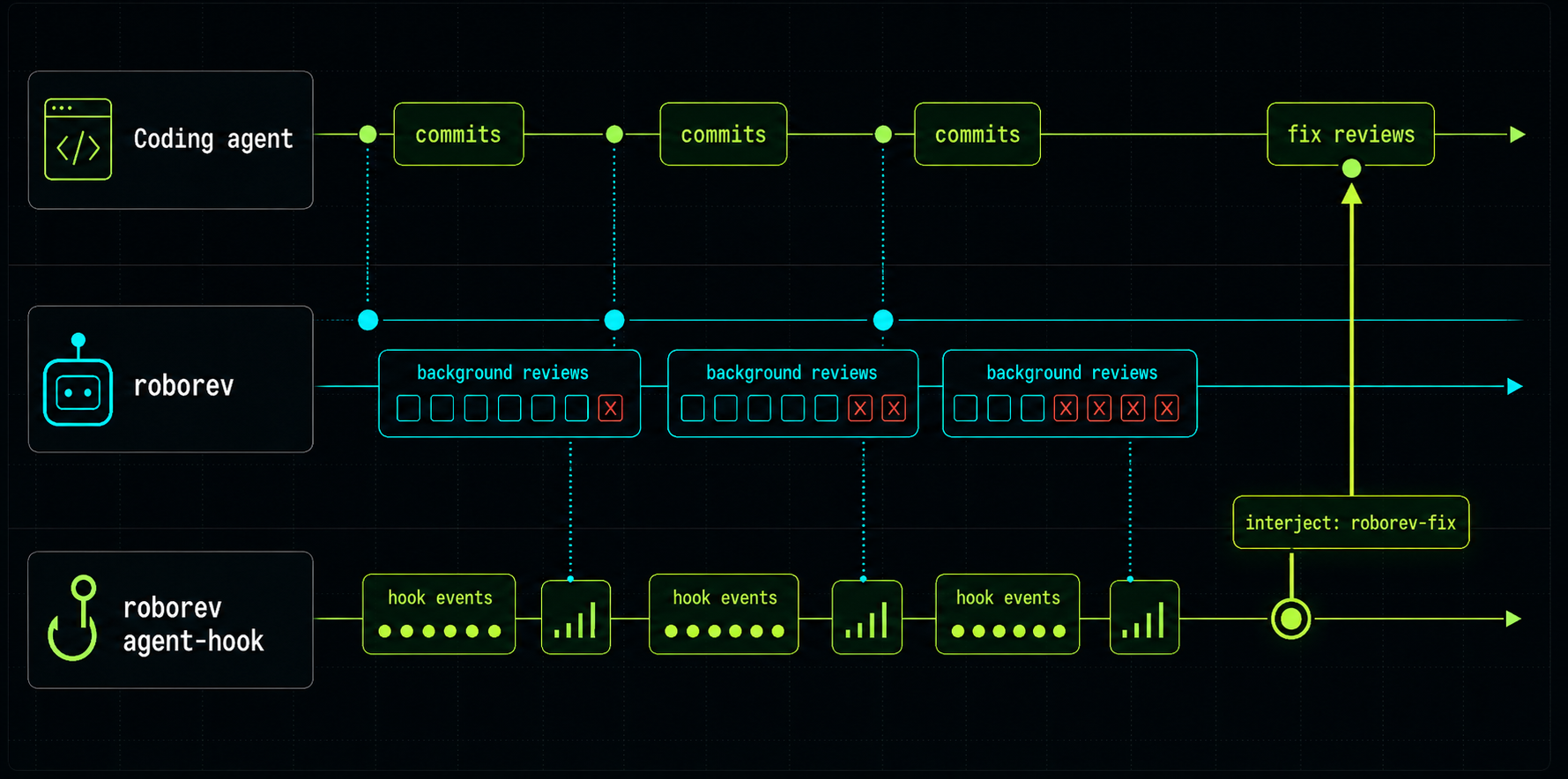
The Loop
Section titled “The Loop”Agents are good at making progress. They are worse at remembering to come back after a background reviewer finishes, especially when reviews happen out of band like they do with roborev.
agent-hook closes that gap. It sits behind Codex or Claude Code hooks, counts what happened in the current session, checks roborev for failed reviews, and returns one direct instruction when there is review work to fix:
Invoke the $roborev-fix skill now.That turns review into part of the agent’s normal rhythm: write code, get reviewed, fix the review, continue.
What It Watches
Section titled “What It Watches”agent-hook tracks three signals per session:
- Turns.
Stophooks, so long-running sessions get periodic review repair. - Commits.
PostToolUseBash hooks that produce commits. APreToolUseBash hook seeds the per-commit baseline so the count stays accurate. - Failed reviews. Open, non-closed roborev reviews with a failed verdict.
agent-hook resolves the repository from the agent’s working directory, so outside a git repository it returns {} and stays out of the way. Reminders also depend on the roborev daemon reporting an open failed review, so a repository roborev does not track never produces a reminder.
If the main roborev daemon is unavailable, the failed-review check is skipped. Turn and commit counts still work through the local hook daemon, but they only prompt the agent once roborev reports at least one open failed review.
Commit-producing Bash calls are counted by default, but commit-based prompts stay off unless commit_threshold is set above 0. Failed-review counts are scoped to the current git branch. Older jobs without a stored branch are included, matching roborev fix discovery.
Quick Start
Section titled “Quick Start”The reminder tells the agent to run the $roborev-fix skill, so install roborev’s agent skills first if you have not already:
roborev skills installThen install the hook entries:
roborev agent-hook installBy default this updates both ~/.codex/hooks.json and ~/.claude/settings.json, registering PreToolUse, PostToolUse, and Stop hooks. Existing hooks are preserved, and repeated installs are idempotent. Use --agent codex or --agent claude to update only one harness, and --dry-run to report what would change without writing.
When roborev is installed through a version manager such as mise, agent-hook install resolves the same stable roborev shim used by roborev init. To pin the exact binary path baked into the agent hook command, use --binary:
roborev agent-hook install --binary ~/.local/share/mise/shims/roborevUse --command only when you want to provide the full hook command yourself. --binary and --command are mutually exclusive.
For declarative setups (Nix home-manager, dotfiles) where editing those files in place is the wrong shape, print the JSON for your config system to consume:
roborev agent-hook dump --agent codexroborev agent-hook dump --agent claudeRuntime Model
Section titled “Runtime Model”Agent harnesses invoke:
roborev agent-hook runrun reads a hook payload on stdin, talks to a small local roborev-agent-hook daemon, and emits the hook response JSON the harness expects. This daemon is separate from the main roborev daemon and stores only local session counters under:
${ROBOREV_DATA_DIR:-~/.roborev}/agent-hook/The main roborev daemon stays the source of truth for reviews and jobs. run auto-starts the local daemon on demand, and it fails open: if the daemon cannot be reached or started, it emits {} and logs the diagnostic to stderr so a hook never blocks the agent. Malformed input or a missing session_id is treated as an invalid harness call and returns a normal CLI error.
Manual daemon management is rarely needed, but it works like the main daemon:
roborev agent-hook daemon start # no-op if already runningroborev agent-hook daemon status # running daemons as JSON (PID, version, address, reachability)roborev agent-hook daemon stoproborev agent-hook daemon restart # replace the daemon with the caller's binaryConfiguration
Section titled “Configuration”Set thresholds in the [agent_hook] section of your global config (~/.roborev/config.toml):
[agent_hook]turn_threshold = 5commit_threshold = 0failed_review_threshold = 4instruction = "Invoke the $roborev-fix skill now."| Trigger | Default | TOML key | run flag | Environment variable |
|---|---|---|---|---|
| Stop hooks (turns) | 5 | turn_threshold | --turn-threshold | ROBOREV_AGENT_HOOK_TURN_THRESHOLD |
| Commit-producing Bash calls | 0 | commit_threshold | --commit-threshold | ROBOREV_AGENT_HOOK_COMMIT_THRESHOLD |
| Open failed reviews | 4 | failed_review_threshold | --failed-review-threshold | ROBOREV_AGENT_HOOK_FAILED_REVIEW_THRESHOLD |
| Continuation instruction | Invoke the $roborev-fix skill now. | instruction | --instruction | ROBOREV_AGENT_HOOK_INSTRUCTION |
| roborev daemon address | runtime discovery | --roborev-server | ROBOREV_AGENT_HOOK_ROBOREV_ADDR |
Set any threshold to 0 to disable that trigger. Values resolve in this order, highest priority first:
run flags > environment variables > [agent_hook] config > defaultsROBOREV_AGENT_HOOK_ROBOREV_ADDR and ROBOREV_AGENT_HOOK_DAEMON_ADDR are operational overrides only and are not persisted in TOML. ROBOREV_AGENT_HOOK_DAEMON_ADDR points run at a specific local hook daemon address.
Inspecting Sessions
Section titled “Inspecting Sessions”Inspect tracked session counters, including remind_count (the number of $roborev-fix reminders emitted), as JSON:
roborev agent-hook statusReset counters when you want a session to start fresh:
roborev agent-hook reset <session-id> # reset one sessionroborev agent-hook reset --all # reset every session